
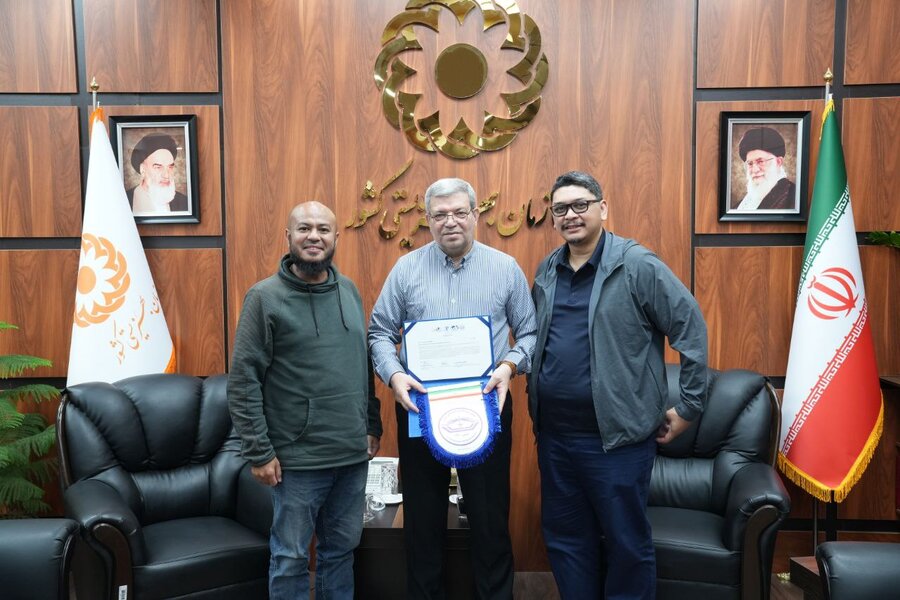
Dr. Mahd Hizan Bin Yahya from Malaysia, President of the Asia-Pacific Association for Social Work Education (APASWE), and Imran Jamil from Singapore, Secretary of the Regional Office of the International Federation of Social Workers (IFSW), will attend the ceremony as foreign guests.
Today, these international guests met with Seyyed Javad Hosseini, Head of the State Welfare Organization, at the Welfare Organization.
Referring to the organization’s activities in the field of women and family, Hosseini said in this meeting: 284,000 female headed of households are covered by the Welfare Organization and they are supported in the fields of nutrition, health, education, social vitality, cultural affairs, and support services.
He added: This year, a health screening plan for female headed of households is being implemented with a budget of 30 billion Tomans. It is also planned to return 1,200 children who have dropped out of school to school.
During the meeting, Imran Jamil, the secretary of the regional office of the International Federation of Social Workers, asked what groups women heads of households include. Hosseini replied: Women heads of households include all categories, some are self-employed girls, more than 40 percent are divorced women, and 24 percent have lost their husbands. There are 6.5 million women heads of households in Iran, 284,000 of whom are covered by the Welfare Organization. These women have a total of 254,000 children, and their family members total 600,000.
According to Hosseini, 43,000 families with multiple children have also been identified, and a total of about 800,000 women heads of households, their children, and families with multiple children are covered by the Welfare Organization. In addition, 1.6 million people with disabilities, 53,000 unaccompanied and abused children, and various other groups also benefit from the services of this organization.
Following the meeting, Mahd Hizan, President of the Asia-Pacific Social Work Education Association, referred to what he had heard about the Welfare Organization's activities in the field of the elderly and domestic violence, and asked for further explanation.
Hosseini replied: There are 10.3 million elderly people living in Iran, and the country's Secretariat for the Elderly is located in the Welfare Organization. Several programs are being implemented in this area, including the creation of 16 elderly-friendly cities with different indicators, indicators to which Iran has also added elderly tourism.
He added: Since 60 percent of the elderly consider loneliness to be their biggest problem, elderly hangouts have been created for social dialogue and interaction. Also, 51,000 elderly women have been identified alone in the country, and their empowerment is on the agenda. A draft bill on the rights of the elderly has been prepared and is undergoing administrative procedures, and a silver employment secretariat for the elderly has also been established.
Continuing, Imran Jamil, referring to the breadth of the Welfare Organization's activities and the limited resources, asked how the prioritization of programs is done. Hosseini replied: There are more than 20 agencies responsible for the elderly, and the Welfare Organization is one of them. The Elderly Council in the Welfare Organization is tasked with coordinating between these agencies.
He added: The main approach of the Welfare Organization is family-oriented, which is why the number of day care centers has decreased and the number of day centers has increased. Small support homes have been developed, and by training formal and informal caregivers, the elderly are supported in their homes to provide them with a better life.
In response to Imran Jamil's question about receiving fees from official caregivers, Hosseini said: Official caregivers receive fees from the elderly or their families for their services. The Welfare Organization pays nursing fees for 242,000 elderly people with disabilities and also provides subsidies to day and night centers. This figure is 12 million tomans per month for unidentified elderly people and 4.2 million tomans for families who care for the elderly at home.
He emphasized: "Lonely elderly women are the next priority of the organization and their number is greater than that of single elderly men." In response to a question about the problems of single elderly women, Hosseini said: "These problems are similar to other societies and the need for interaction and social support increases during old age. The elderly themselves have stated that loneliness is their number one problem. For elderly women, only empowerment programs, the creation of senior hangouts, and even the issue of remarriage have been considered."
Hosseini also referred to the implementation of the “Kind Hands” project and said: In this project, unaccompanied children and the elderly are placed next to each other to strengthen intergenerational bonds.
Continuing the meeting, Imran Jamil asked: Has Iran entered the aging stage? Hosseini replied: 14 percent of the country’s population is elderly and Iran has entered the aging stage. If 7 percent of a country’s population is elderly, that country is considered young; 7 to 14 percent is considered the aging stage, 14 to 21 percent is considered an elderly country, 21 to 27 percent is considered an elderly country, and more than 27 percent is considered a severely elderly country.
He added: Aging in Iran has three characteristics; first, the high rate of aging, with a population growth rate of 1.4 percent and an aging growth rate of 4.7 percent. While the global average of aging is 80 years, Iran has aged in 30 years and it is predicted that by 1430, more than 30 percent of the country's population will be elderly. Second, aging in Iran is multi-layered and is accompanied by disability, poverty, illiteracy, disease, and loneliness. Third, the structure and planning have not been developed in line with this speed and complexity, and there is a kind of structural and administrative delay and cognitive error in dealing with aging.
Referring to the experience of Singapore, Imran Jamil continued: The fertility rate in our country is less than one percent and we were forced to accept immigration, which itself has created social problems. For years, we have designed places where the elderly and children can be together, and this model has been very successful, so that the child sees the elderly as his grandfather or grandmother, and the elderly see the child as his grandchild. Now, these day care centers have been developed in different cities, and kindergartens have been established next to the nursing homes.
Next, Hosseini asked about the Singapore government's subsidy to the private sector, and Imran Jamil replied: The government provides subsidies, but not in large amounts.
Mahd Hizan, president of the Asia-Pacific Social Work Education Association, also said: In Malaysia, the birth rate has decreased and nutritional supplements are provided for children aged 7 to 12 in schools, which has had a significant impact. Also, free syringes are distributed among injection drug addicts to reduce the incidence of AIDS.
In response to this issue, Seyyed Hassan Mousavi Chelak, deputy director of social health at the Welfare Organization, said: This program is also implemented in Iran and is legal. Free syringe distribution is carried out through the non-governmental sector, and mobile centers visit addicts' hangouts and provide services. These centers operate with a license from the Welfare Organization, and the establishment of safe injection rooms is also on the agenda.
At the end of the meeting, Mahd Hizan said: Before traveling to Iran, we did not imagine that the planning would be so precise and that Iran has valuable capacities and experiences that the world is unaware of. Referring to his recent speech at the United Nations, Hosseini said: Iran has conducted 62 million vision screenings and saved 550,000 people from blindness and has managed to reduce the rate of amblyopia from four percent globally to 1.5 percent.
He added: There are many similar successful examples in Iran, but due to the oppressive nature of the country, the United States and Israel are trying to show Iran's image as weakened. However, these efforts have failed.
Hosseini then asked about the way the Welfare Organization provides services in Malaysia and Singapore. Imran Jamil explained that in Singapore, the elderly are followed up by the Ministry of Health and other social issues are divided among various ministries and an institution called "Social Integration" is responsible for coordinating them. Mahd Hizan also said: In Malaysia, the Ministry of Women, Family and Social Development is responsible for these areas.
Your Comment